What is Reinforcement Learning? Definition, Concepts, Applications, and Challenges - AI Encyclopedia
Reinforcement learning (RL) is a branch of machine learning that focuses on training algorithms to make decisions through interaction with their environment. It is inspired by how humans and animals learn from their experiences to achieve goals. In this paper...
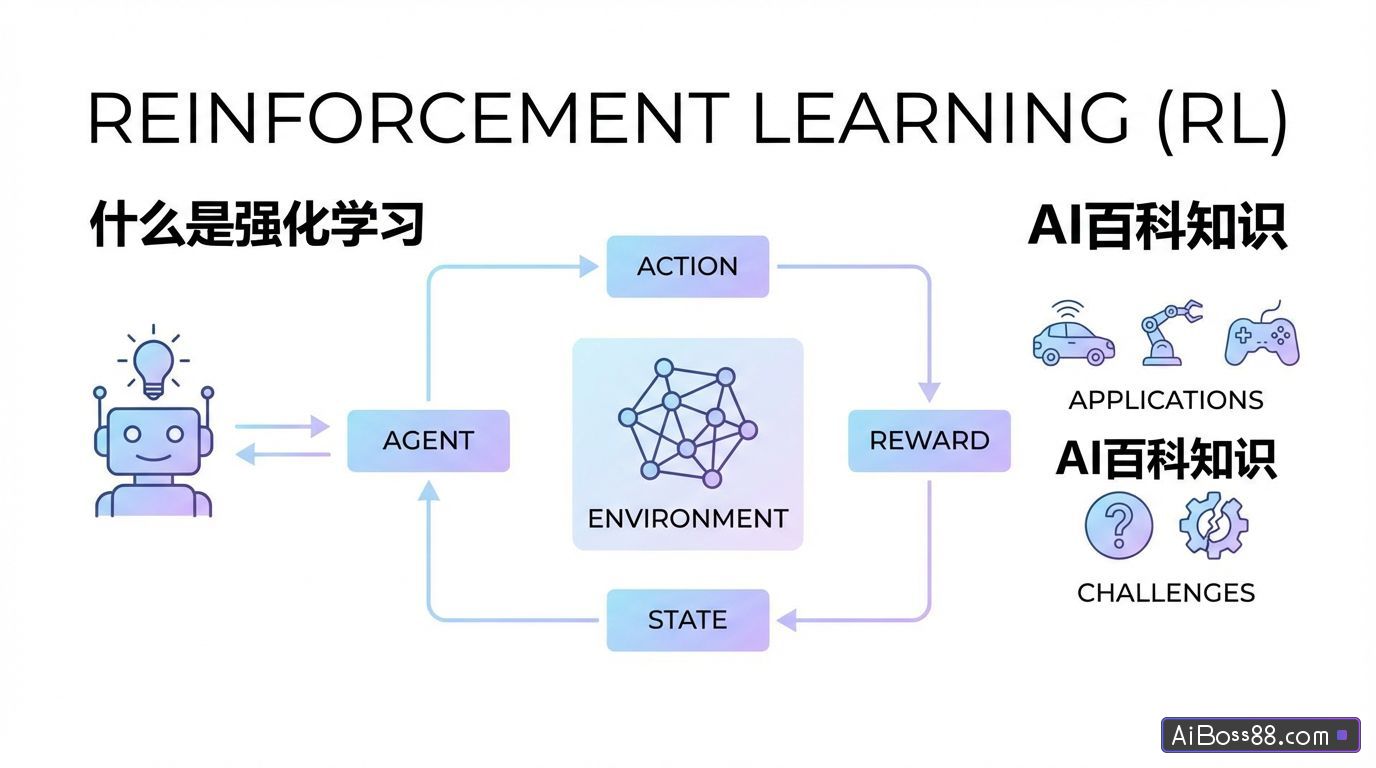
Reinforcement learning (RL) isMachine LearningA branch of reinforcement learning that focuses on training algorithms to make decisions through interaction with the environment. It is inspired by how humans and animals learn from their experiences to achieve goals. In this article, we will provide a comprehensive overview of reinforcement learning, its key concepts, and applications.
I. What is reinforcement learning?
Reinforcement learning (RL) is a type of learning...Machine LearningThe approach emphasizes learning how to make decisions through interaction with the environment. In reinforcement learning, an agent learns to take actions in a specific environment to maximize the cumulative reward it receives. The learning process involves trial and error, and the agent learns from both positive and negative feedback.
This learning paradigm originates from psychology, particularly the study of operant conditioning, through which organisms learn to associate actions with consequences. In recent years, reinforcement learning has gained immense appeal due to its ability to solve complex problems requiring continuous decision-making.
II. Key Concepts and Terminology in Reinforcement Learning
To better understand reinforcement learning, you should familiarize yourself with the following key concepts and terms:
- Agent(often translated as:intelligentbodyIndividual, subject, player): Learners or decision-makers in the reinforcement learning process.intelligentbodyInteract with the environment and take action to achieve specific goals.
- Environment: intelligentbodyThe operating environment. It provides...intelligentbodyProvide observation, andintelligentbodyActions can influence the state of the environment.
- State: intelligentbodyA representation of the current state of the environment. It can be fully or partially observable.
- Action: intelligentbodyThe decisions made that affect their interaction with the environment.
- Reward: intelligentbodyAn immediate feedback signal received after an action is taken. The reward reflects the desirability of the action taken in a given situation.
- Policy: intelligentbodyThe strategy for choosing actions can be deterministic or random.
- Value function: An estimateintelligentbodyA function of the expected cumulative reward that can be obtained, starting from a given state and following a specific policy.
- Q-function: An estimateintelligentbodyA function that yields the expected cumulative reward, starting from a given state, taking a specific action, and then following a specific policy.
- Exploration vs. Exploitation: The trade-off between trying new actions to discover their consequences (exploration) and choosing actions known to yield high rewards (exploitation).
III. Main Types of Reinforcement Learning
There are three main types of reinforcement learning:
- Model-free RL: In this approach,intelligentbodyIt cannot obtain a dynamic model of the environment. Instead, it learns directly from its interactions with the environment, typically by estimating the value function or Q-function.
- Model-based RL: In this approach,intelligentbodyAn environmental dynamics model was constructed and used for planning and decision-making. Model-based RL can lead to more efficient learning and better performance, but it requires accurate models and more computational resources.
- Inverse RL: In this approach, the goal is to learn the basic reward function of expert demonstrators by observing their behavior. This can be helpful when manually designing a suitable reward function is challenging.
IV. Typical Algorithms of Reinforcement Learning
Over the years, researchers have proposed various reinforcement learning algorithms, among which the most notable include:
- Value Iteration: A dynamic programming technique that iteratively updates the value function until it converges to the optimal value function.
- Q-learning: A model-free, non-strategy-based algorithm that learns the optimal Q-function by iteratively updating its estimates based on observed transitions and rewards.
- SARSA: A model-free policy algorithm that learns the Q-function by updating its estimate based on the actions taken by the current policy.
- Deep Q-Networks (DQN): An extension of Q-learning that uses deep learning.Neural NetworksThis approximates the Q-function, enabling RL to be extended to higher-dimensional state spaces.
- Policy Gradient Methods: A family of algorithms that directly optimize a policy by adjusting its parameters based on the gradient of the expected cumulative reward.
- Actor-Critic Methods: A class of algorithms that combine value-based and policy-based approaches by maintaining separate estimates of the policy (actors) and the value function (judges).
- Proximal Policy Optimization (PPO): A policy gradient approach that balances exploration and exploitation by using a trust region optimization method.
V. Application Scenarios of Reinforcement Learning
1. Robotics and Motion Control
Reinforcement learning has been successfully applied in robotics, enabling robots to learn complex tasks such as grasping objects, walking, and flying. Researchers have used RL to teach robots to adapt to new environments or autonomously recover from damage. Other applications include optimized control of robotic arms and multi-robot cooperative systems, where multiple robots work together to complete tasks.
2. Human-computer games
Reinforcement learning has been a key force in developing players capable of playing games at a superhuman level. AlphaGo and subsequent versions by DeepMind have demonstrated the power of RL in mastering the game of Go, which was previously considered...artificialintelligentIt's impossible to do that. RL is also used to train players to play Atari games, chess, poker, and other complex games.
3. automaticdrive
One of the most promising applications of reinforcement learning is in the development ofautomaticIn the area of driving, reinforcement learning allows subjects to learn to navigate complex traffic scenarios and make informed decisions.intelligentThe decision was made to avoid collisions and optimize fuel consumption. Researchers are also exploring multi-agent reinforcement learning to simulate interactions between multiple vehicles and improve traffic flow.
4. Quantitative Financial Trading
Reinforcement learning has been used to optimize trading strategies, manage portfolios, and predict stock prices. However, considering transaction costs and market volatility, RL...intelligentbodyIt can teach you how to maximize profits by making informed decisions about buying and selling stocks. Furthermore, RL can be used for algorithmic trading.intelligentbodyLearn to execute orders effectively to minimize market impact and reduce transaction costs.
5. Healthcare
In healthcare, Responsibility Research (RL) can be applied to personalized medicine, aiming to find the best treatment plan for each individual patient based on their unique characteristics. RL can also be used to optimize surgical scheduling, manage resource allocation, and improve the efficiency of medical procedures.
VI. Challenges Facing Enhanced Learning
1. Sample efficiency
One of the biggest challenges of reinforcement learning is the need for large amounts of data for training.intelligentbodyThis can be time-consuming and computationally expensive, limiting the applicability of RL in real-world scenarios. Researchers are working to develop more sample-efficient algorithms.intelligentbodyThey are able to learn from limited interaction with their environment.
2. Exploration and Utilization
Balancing exploration (trying new actions to discover their effects) and exploitation (using the most well-known actions) is a fundamental challenge in reinforcement learning. Insufficient exploration can lead to suboptimal policies, while excessive exploration wastes valuable resources. Developing algorithms that can effectively balance exploration and exploitation is an active area of research.
3. Transfer learning and generalization
Training RLintelligentbodyExtending learned knowledge to new tasks and environments is a key challenge. Transfer learning, a method designed to transfer knowledge gained in one task to another related task, is an increasingly popular approach to addressing this challenge. Researchers are exploring how to make transfer learning...intelligentbodyIt is more adaptable and can transfer its knowledge to a wide range of tasks and environments.
4. Safety and robustness
Ensure RLintelligentbodySecurity and robustness are of paramount importance, especially in [specific contexts].automaticIn applications such as driving and healthcare, errors can have serious consequences. Researchers are working to develop methods that incorporate safety constraints into the learning process, enabling...intelligentbodyIt is more robust against adversarial attacks and can handle uncertain or incomplete information.