What is a Bayesian Network? - AI Encyclopedia
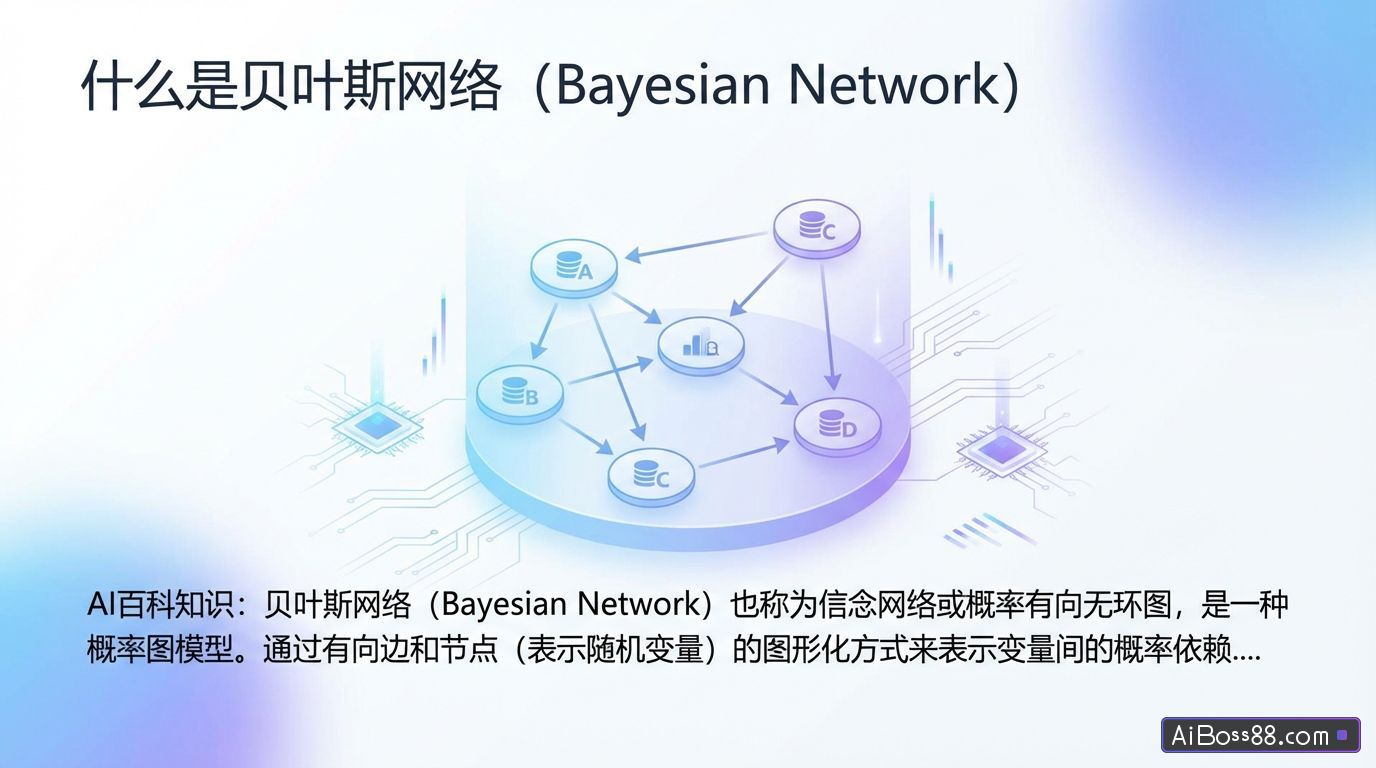
A Bayesian Network, also known as a belief network or probabilistic directed acyclic graph, is a probabilistic graphical model. It uses directed edges and nodes (representing random variables) to graphically represent the probabilistic dependencies between variables...
In a world of uncertainty, Bayesian networks, with their unique probabilistic reasoning capabilities, have become a key tool for exploring knowledge and truth in this field.powerfulTools. Since the birth of Bayes' theorem in the 18th century, Bayes' theorem has continuously evolved, eventually forming Bayesian networks that can graphically represent complex probabilistic relationships.Machine LearningandartificialintelligentThey have shone brightly in the field, and even more so in medical diagnosis, risk assessment,Natural Language ProcessingIt has demonstrated its enormous potential in multiple fields.practicalValue. With the continuous advancement of technology, Bayesian networks are gradually becoming an important tool for understanding and predicting the world. This article will delve into the basic principles, construction methods, and application prospects of Bayesian networks in modern technology, revealing how this probabilistic graphical model can help us make more informed decisions in a world full of variables.
What is a Bayesian network?
Bayesian networks (Bayesian NetworkA Bayesian network, also known as a belief network or probabilistic directed acyclic graph, is a probabilistic graphical model. It uses directed edges and nodes (representing random variables) to graphically represent probabilistic dependencies and causal relationships between variables. Bayesian networks are effective for probabilistic reasoning and decision analysis, and are widely used in medical diagnosis, risk assessment, and other fields.Natural Language ProcessingIn fields such as [unspecified areas], networks update beliefs based on Bayes' theorem, that is, inferring the probability of an event occurring given evidence.
How Bayesian Networks Work
Bayesian networks (Bayesian NetworkThe working principle of this method is based on Bayes' theorem, which is a method for calculating the probability of an event given other related events. It constructs a directed acyclic graph (DAG), where nodes represent random variables and edges represent probabilistic dependencies between variables. Given observed evidence, the network uses conditional probability and the chain rule to update and calculate the posterior probabilities of variables, enabling reasoning and prediction for uncertain problems. This method allows for the inference of the most probable conclusions or predictions even with incomplete information, by integrating prior knowledge and new observational data.
Main applications of Bayesian networks
Bayesian networks have wide applications in many fields. Here are some of the main application areas:
- Medical diagnosisBayesian networks can be used to build disease diagnostic models, assisting doctors in making more accurate diagnoses. By combining information such as a patient's symptoms, signs, and medical history, Bayesian networks can help doctors infer possible diseases. For example, in the diagnosis of hypertension, environmental and genetic factors can be considered, and the accuracy of diagnosis can be improved by combining ontology and Bayesian networks.
- Financial risk managementIn the financial sector, Bayesian networks are used for risk assessment, risk prediction, and risk monitoring. They can predict changes in market indicators such as stock indices, exchange rates, and interest rates, helping financial institutions assess and manage market risk, credit risk, and interest rate risk.
- Natural Language ProcessingBayesian networks inNatural Language ProcessingIt also has applications in Natural Language Processing (NLP), particularly in text classification and sentiment analysis. It helps computers understand and process human language by modeling the relationships between features and categories in text to achieve text classification and sentiment analysis.
- Decision support systemBayesian networks are due to theirpowerfulThe ability to express and reason about uncertain knowledge is used to...intelligentDecision support systems enhance a system's ability to support decisions on uncertain problems. They can learn from databases and knowledge bases, combining prior knowledge with observational data to provide effective decision support.
- Industrial ControlIn industrial processes, Bayesian networks can be used for soft measurement modeling to solve the problem of measuring process variables that are difficult to measure online. Through graphical model representations, they infer unknown information from sample data, providing an effective means for industrial control.
- Risk AnalysisBayesian networks are used in risk analysis to comprehensively and accurately identify and assess risks. They combine qualitative and quantitative analysis to evaluate the probability and impact of risk occurrence and quantify the magnitude of risk.
Challenges of Bayesian Networks
While Bayesian networks have wide applications in many fields, they also face some challenges and limitations:
- Structural learning complexityDetermining the optimal structure of a Bayesian network can be very complex, especially when there are many variables.
- Data sparsity problemIn some cases, the available data may not be sufficient to accurately estimate the conditional probability table, leading to performance degradation.
- Causal relationship hypothesisBayesian networks are typically modeled based on causal relationships, but real-world data may contain hidden or unobserved variables that could affect the accuracy of causal inferences.
- Computational resource consumptionFor large-scale networks, inference and learning in Bayesian networks may require a large amount of computational resources.
- Dependence on prior knowledgeBuilding an effective Bayesian network may require prior knowledge from domain experts, which may be difficult to obtain in some cases.
- Dynamic system modelingFor dynamic systems that change over time, dynamic Bayesian networks are required, which increases the complexity of modeling.
- Handling nonlinear relationshipsWhile nonlinear relationships can be handled by introducing latent variables, this increases the complexity of the model and the computational burden.
- Model validation and testingVerifying the accuracy and reliability of Bayesian networks can be challenging, especially when sufficient test data is lacking.
- Scalability issuesAs the network grows in size, the difficulty of maintaining and updating the Bayesian network also increases.
- Model comparison and selectionChoosing the best model from multiple candidate models may require complex model selection criteria and cross-validation processes.
The Development Prospects of Bayesian Networks
The future prospects for Bayesian networks appear positive, with the improvement of computing power and...Machine LearningTechnological advancements are expected to...automaticDecision support systems, complex system modeling, personalized medicine,intelligentData analytics and other fields are playing an increasingly important role. Meanwhile, researchers are working to develop more advanced technologies.High efficiencyAlgorithms are used to process large-scale data, improving the model's learning and reasoning abilities, as well as enhancing its interpretability and understandability. Furthermore, Bayesian networks and...Deep learningThe combination of these technologies with other technologies is also expected to promote the application of Bayesian methods in dealing with more complex and high-dimensional problems.