
Cornell University's "AI Agents vs. Agentic AI: Conceptual Classification, Applications, and Challenges"
Cornell University's "AI Agents vs. Agentic AI: Conceptual Classification, Applications, and Challenges"
"AI Agents vs. Agentic AI: Conceptual Classification, Applications, and Challenges" is a book published by a research team from Cornell University and other universities. It provides an in-depth analysis of the easily confused core concepts of AI Agents and Agentic AI, exploring the topic of intelligent...
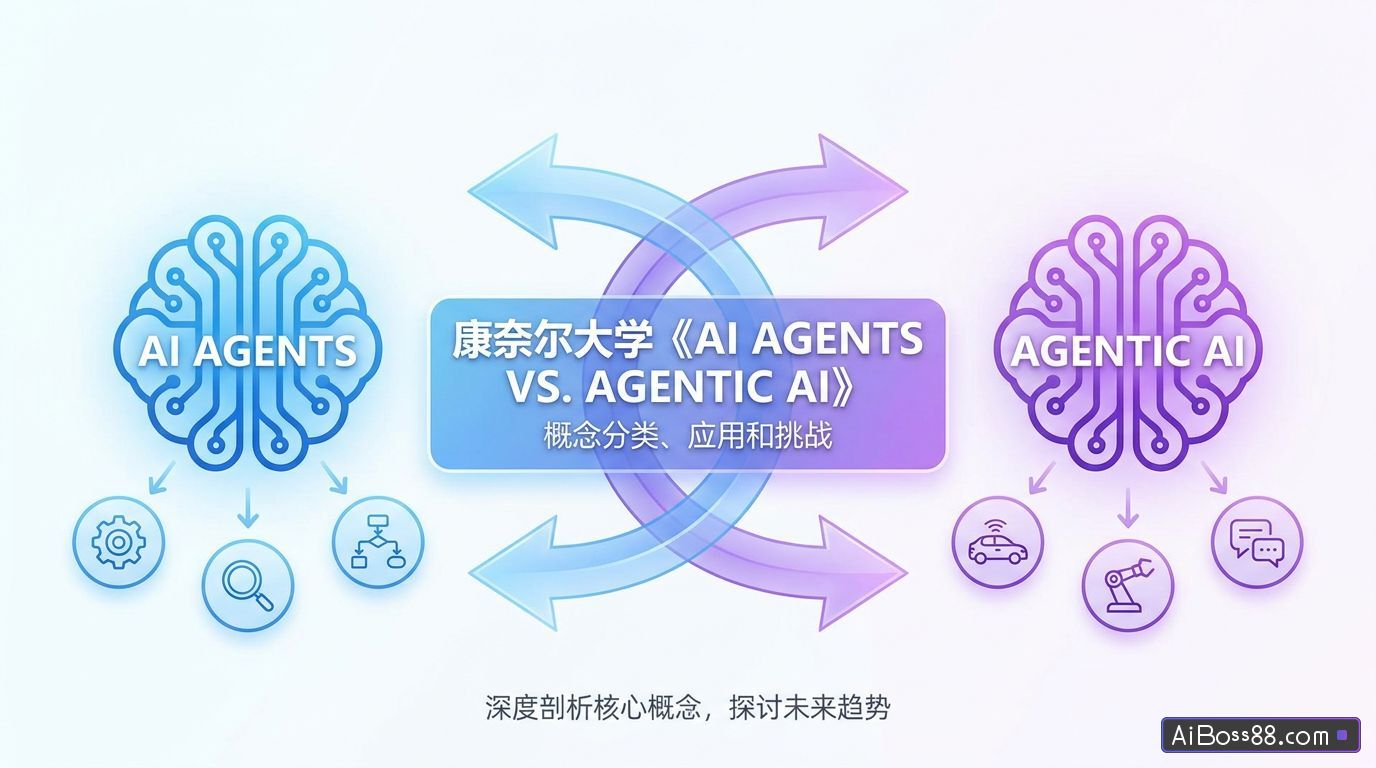
《AI Agents vs. Agentic AI"Concept Classification, Applications, and Challenges" is a research project published by a research team from Cornell University and other universities in the United States, providing an in-depth analysis of...AI Agents andAgentic AIThis set of easily confused core concepts will be discussed.intelligentbodyBottlenecks in technological development and solutions.
To address these challenges, developers have introduced various technical approaches. For example, RAG (Retrieval Augmentation) technology can reduce the hallucination problem; causal modeling can improve reasoning ability; and multiple...intelligentbodyMemory architectures (such as vector memory) enhance information sharing efficiency; stronger planning mechanisms (such as mind trees) optimize multi-step decision-making. These technologies will help...intelligentbodyTechnological breakthroughs.
AI Agents will be based on modular designintelligentCapabilities are enhanced, gradually evolving into the ability to "take initiative"intelligent"ofintelligentbodyIndependent planning and decision-making.Agentic AImuchintelligentbodyThe collaboration framework will mature further, forming a highly organized "system".intelligent",forAIThe development of this brings new opportunities and breakthroughs.
AI Agents:AI Agents is based onAIThe technology is an autonomous software system that independently perceives, makes decisions, and executes tasks in a specific environment. Its core characteristics include:
- Autonomous operation:AI AgentIt completes tasks independently without real-time human supervision. Supports...automaticStart working, based on the built-in...intelligentThe algorithm makes decisions and runs 24/7.
- Clear goalsEachAI AgentAll tasks revolve around a specific goal. Large tasks are broken down into smaller steps.intelligentArrange the execution sequence and continuously evaluate the quality of completion.
- Environmental perception:AI AgentIt can understand various types of information, including text, voice, and images. It adjusts its operating methods based on real-time conditions and connects to other systems for collaborative work.
- Continuous progress:AI AgentLearn from each job experience, optimizing yourself based on analysis of successful and unsuccessful cases. Remember user preferences.automaticAdjusting work methods, inrecommendThe more you use it in systems and other services, the more...intelligent.
Agentic AI:and AI Agent different,Agentic AIIt is a new typeintelligentArchitecture refers to multipleAI AgentComposed of collaborative mechanismsintelligentThe system possesses advanced capabilities for handling complex tasks. Its core features include:
- manyintelligentbodyCollaborative ArchitectureMultiple specializationsAgentDivision of labor and cooperation, based onintelligentCommunication mechanisms to implement complex tasksHigh efficiencyimplement.
- Advanced task planning capabilitiesIt possesses the ability to recursively decompose tasks, perform multi-path reasoning, and dynamically adjust to handle complex problems.
- Distributed memory systemCombining globally shared memory with individual-specific memory, it supports cross-platform...intelligentbodyKnowledge retrieval and storage.
- YuanintelligentbodyCoordination mechanismBased on central scheduling, quality monitoring, and a security sandbox, ensure multipleAgentReliability and security of collaboration.
- Self-evolution ability:intelligentbodyShare experiences and optimize collaboration strategies to drive continuous improvement in overall system performance.
The research team based onintelligentHome system case studies illustrate AI Agent and Agentic AI The difference between them.
This comparison image vividly illustratesAITechnology is evolving from single-function to systemintelligentEvolution of: Left sideAI Agent(likeintelligentThermostat represents the basicintelligentThe unit focuses on independently performing specific tasks (such as temperature regulation) and has limited self-learning and rule-based response capabilities; the one on the right...Agentic AIThe system builds a multiintelligentbodyCollaborative networks (integrating modules such as weather forecasting, energy management, and security) enable cross-domain collaborative optimization based on real-time data sharing and dynamic decision-making (e.g., combining electricity prices with weather forecasts).automatic(Regulating the home environment). The essential difference between the two lies in the fact that the former is a "functional executor," while the latter is a "system decision-maker," signifying...AIFrom isolated tools to organizational-level toolsintelligentThe ecological hub leaps across, in order to cope with complex scenarios (such as...)intelligentIt provides a key technology paradigm for cities and industrial IoT.
AI AgentApplication areas:
- Customer Serviceautomaticchange::intelligentThe customer service system can perform tasks based on preset rules and user input.fastAnswer common questions accurately to improve customer satisfaction.
- Schedule:automaticAnalyze users' schedules to schedule meetings and events effectively and avoid time conflicts.
- Data Summary:automaticExtract and summarize key information from large amounts of data to generate concise reports.
- Email filtering:automaticCategorization and prioritization help users manage high-volume emails.
- Personalized contentrecommendBased on user behavior and preferences,recommendPersonalized content, such as news, music, and videos.
- automaticDocument processing:automaticExtract and process information from documents to generate summaries or reports.
Agentic AIApplication areas:
- Researchautomaticchange:automaticStreamline the scientific research process, including literature retrieval, experimental design, and data analysis.
- Robot CoordinationCoordinate multiple robot systems to complete complex tasks, such as logistics delivery and environmental monitoring.
- Medical decision supportProvides medical diagnosis and treatment plans.recommendServices such as patient monitoring.
- intelligentTransportation systemOptimize traffic flow and manageautomaticCoordination and scheduling of driving vehicles.
- supply chain managementOptimize resource allocation, logistics scheduling, and inventory management in the supply chain.
- intelligentEnergy ManagementOptimize energy consumption and manageintelligentPower grids and distributed energy resources.
AI Agents:inheritLarge ModelWeaknesses (hallucinations, superficial reasoning), lack of long-term memory and proactive goal setting. Specifically, these manifest in the following ways:
- Lack of causal understanding:AI AgentThey have difficulty distinguishing between correlation and causation, leading to poor performance when faced with new situations.
- LLM Inherent limitationsProblems such as hallucination, cue sensitivity, superficial reasoning, knowledge deadlines, and bias can generate inaccurate information and affect reliability.
- Incompleteintelligentbodyproperty:AI AgentInsufficient autonomy, lack of initiative, and weak social skills limit the scope and functionality of applications.
- Lack of long-term memoryIt is difficult to perform multi-step planning and handle task failures, which limits its adaptability in complex environments.
Agentic AI:manyintelligentbodyMisinformation, lack of unified standards, and security and ethical risks. These are specifically manifested in the following aspects:
- Error propagation:singleAgentErrors can be amplified through multiple layers of the collaboration chain, contaminating the entire system's decision-making.
- System stability:manyAgentDynamic game theory can easily lead to decision-making oscillations, and the success rate of tasks varies.AgentThe number increased but decreased significantly.
- Protocol fragmentationDifferent frameworks use independent communication protocols (such as gRPC/JSON-RPC), resulting in poor cross-platform interoperability.
- Verification difficulties:manyAgentThe number of interaction path combinations has exploded, and existing testing tools can only verify...SimpleCollaboration chain.
- Expanding bottlenecksMore than 7AgentCollaboration efficiency plummeted, and hardware performance became a hard constraint for large-scale deployment.
Technical solutions
solveAI Agents andAgentic AI10 Solutions to the Diverse Problems Faced:
- Search Enhancement Generation (RAG)Based on real-time retrieval of external knowledge bases, forintelligentbodyProvide fact-checking capabilities to reduce hallucinatory output (such as customer service).AgentCallup to dateProduct database response).
- Tool-enhanced reasoning: to giveintelligentbodyAPI access permissions (such as querying weather/stock prices), expanding its ability to solve problems (such as investment)Agentautomatic(Obtaining financial data to support decision-making).
- intelligentbodyBehavior CycleEstablish a closed-loop mechanism of "reasoning-action-observation" (such as writing).Agent(First create an outline, then generate the content in segments) to improve the rigor of decision-making.
- Hierarchical memory architectureUse episodic memory (short-term conversations) + semantic memory (long-term knowledge) + vector memory (fastA three-tier storage system for retrieval.
- Role-playingAgentArrangementDivision of labor like company departments (e.g., Meta)GPT(The CEO/CTO role) improves collaboration efficiency based on specialization.
- Self-criticism mechanismSet up verificationAgent(Such as an auditor) cross-check outputs to reduce the risk of error propagation.
- Procedural prompting engineeringUse templatesPrompt words(e.g., "You are a senior doctor") StandardizedAgentBehavior that reduces randomness.
- Causal modelingConstructing causal graphs distinguishes between correlations (such as "cough-cold") and causal relationships, thereby enhancing the credibility of inferences.
- Explainable pipelineRecord complete decision logs (such as AutoGen's dialogue history) to support fault backtracking and accountability.
- Governance Awareness ArchitectureImplement sandbox isolation (such as financial)AgentTransaction limits and RBAC access control ensure system security.
Future development direction
AI AgentsFrom passive response to proactiveintelligent(Proactive Intelligence).
- Autonomous decision-makingNo longer limited toSimpleTask execution, based on context and objectives, actively reasoning and autonomously planning action paths (e.g.)intelligentThe assistant proactively reminds participants of the meeting and prepares materials.
- Tool IntegrationDeeply integrate with external APIs, databases, and physical devices (such as robots calling industry knowledge bases or controlling robotic arms) to expand the boundaries of capabilities.
- Causal ReasoningBeyond correlation analysis, understanding "why" improves decision reliability (e.g., medical diagnosis).AgentDistinguish symptom causal chains.
- Continuous Learning: Optimization based on online learning and feedback (e.g.)recommendThe system adapts to user preferences in real time, achieving long-term performance improvements.
- Trust & SafetyIntroduce interpretability, audit logs, and value alignment mechanisms to ensureAIThe behavior is ethical and controllable.
Agentic AIFrom singleintelligentbodyTo the systemintelligent(Systemic Intelligence).
- manyintelligentbodyMulti-Agent ScalingBuilding large-scale collaborative networks (such as thousands of networks in urban traffic management)Agent(Collaborative optimization of traffic lights).
- Unified OrchestrationDevelop standardized communication protocols and scheduling frameworks (similar to Kubernetes for containers) to achieve cross-platform compatibility.AgentCollaboration.
- Persistent memorySupport for long-term knowledge preservation (such as scientific research)Agent(Systematically accumulate research history in the field) to avoid redundant learning.
- Simulation Planning: Rehearsing decision-making in a virtual environment (e.g.)automaticdriveAgent(By testing extreme scenarios using digital twins, we can reduce real-world risks.)
- Ethical GovernanceEstablish multipleAgentA system for tracing responsibility (such as blockchain evidence storage) ensures compliance with laws and social norms.