
What should you learn when learning AI? - Illustrated Skill: A Practical Guide to Improving Efficiency with AI (PDF file)
What should you learn when learning AI? - Illustrated Skill: A Practical Guide to Improving Efficiency with AI (PDF file)
The author of "Illustrated Skills: A Practical Guide to AI Efficiency" and maintainer of the open-source project baoyu-skills shares in-depth insights on "What should we actually learn in AI?" His core argument is that the highest-return area for learning AI today is not...
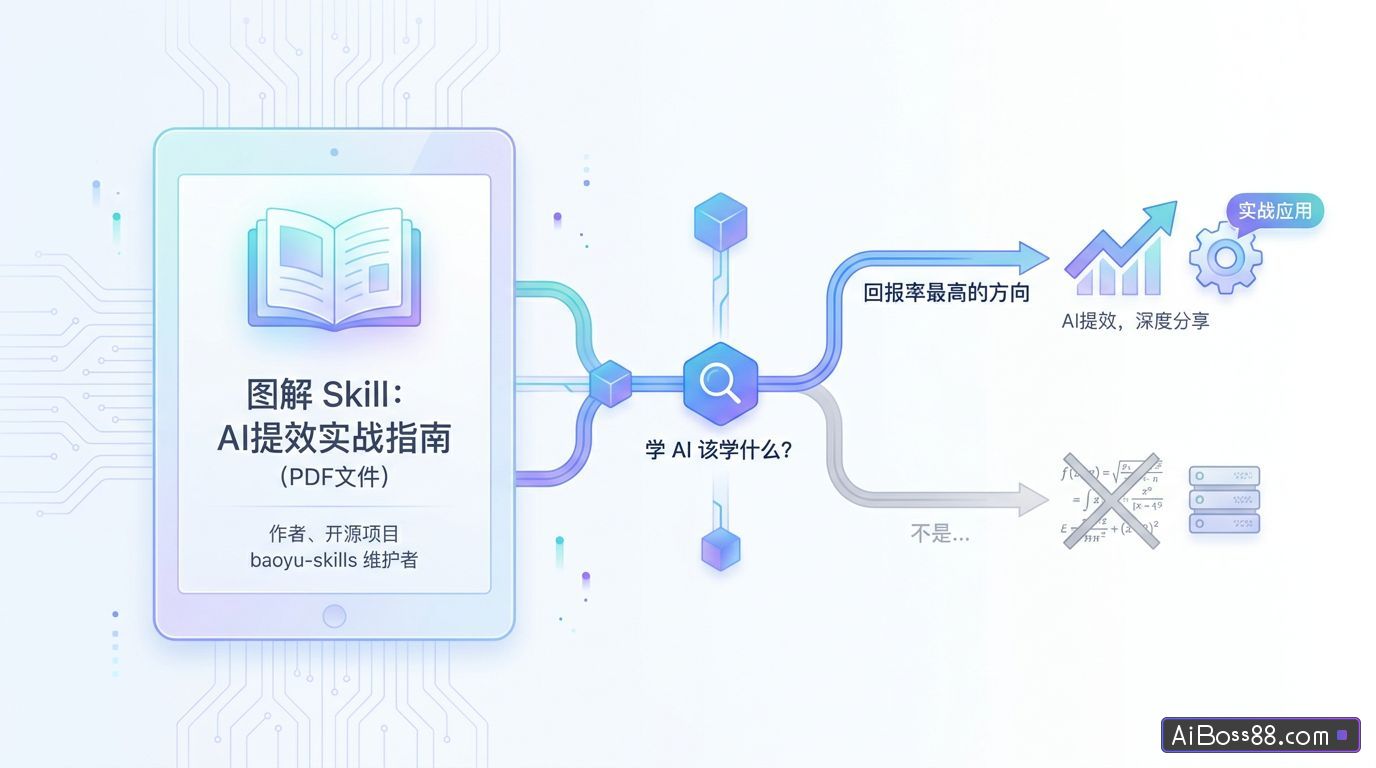
Illustrated Skill:AIAuthor of "Practical Guide to Improving Efficiency"open sourceThe maintainer of the baoyu-skills project, regarding "We Learn..."AIThe in-depth sharing on "What should we learn?" has the core argument that...Learning nowAIThe highest-return approach is not chasing new models, nor memorizing...Prompt wordsInstead, turn what you do repeatedly into...AISkills that can be performed (Agent Skills).
Scan the QR code to follow our official WeChat account and reply with the following code:20260625Get the complete source file of the PDF.
I. Core Judgment Framework: Two Axes Determine What to Learn
-
Bottom left corner (far + short): Skip directly — Monthly updates on model benchmarks, funding gossip, chip parameter details, and the fact that the vast majority of these models don't survive more than six months.AIA reskinned product. Skipping it won't cost you anything; the important thing is that it's still there three months later.
-
Top left corner (far + long): Maintain map awareness — RAG, CoT (Cooperation on Thinking), Scaling LawsAIHallucination/MultimodalThese are fundamental concepts. You only need to read a good explanation; you can understand them in 15 minutes without any hands-on experience.
-
Bottom right corner (near + short): Use but don't shoot too deep. —— AIDrawing tools, browserintelligentbodyLearn how to operate a product. Spend a few hours getting used to it, rather than a week mastering it; if you get replaced, you'll only lose a few hours.
-
Top right corner (near + long): Deep investment —— Promptproject,AI Agent,Agent Skills (turning experience into skills)This is the area with the fewest participants, but the one most worthy of serious investment.
What is a "skill"?
-
nature: Condense your business experience into an executable and reusable operating procedure.
-
formA folder = SKILL.md (core instruction manual) + optional scripts and reference documents.
-
thresholdNo programming is required; you can do it if you can write Chinese.
-
Compound interest effectDo it once, use it a hundred times; as models evolve, your skills will never be outdated.
II. Four real-world examples (all of which are tasks the author performs daily).
| Case | Pain points | The effect after skillification |
|---|---|---|
| Case Study 1: PPT Creation | Repeated communication on format + manual typesetting | A single sentence generates a visually appealing finished product; the author is only responsible for topic selection and final review. |
| Case Study 2: News and Information Processing | More than a dozen news items a day are impossible for a person to handle manually. | The topic selection is determined by people, while the material retrieval, analysis, and drafting are all handled by Skill, with one article every 5 minutes. |
| Case Study 3: The Entire Process of WeChat Official Account Articles | There are many stages involved in writing, polishing, layout, adding illustrations, and publishing. | The workflow is built step-by-step over four weeks: initial draft by hand → writing style skills → formatting → cover/illustrations → One-clickPublish to WeChat Official Account/X/Blog |
| Case Study 4: Data Analysis Report | The analysis is too superficial, only calculating the mean, and the report format is ugly. | V1 (20-line SKILL.md file runs but is rough) → V2 (Injection analysis framework is in-depth) → V3 (Mounted template + design brief = deliverable quality) |
Common logic: You are in charge (responsible for topic selection, judgment, and acceptance).AIOdd jobs (writing drafts, revising format, adding illustrations, and typesetting).
III. Three Methods for Creating Skills
-
Method 1: andAgentDo it all at once, then let it cure. — You perform the operation on your Mac,AgentObservational learning directly solidifies into repeatable skills. It has the lowest barrier to entry; nothing needs to be written down.
-
Method Two: You are the director; express your ideas and make them come true. — Clearly state your requirements → Generate an initial version using Skill Creator → Test on a real task → Provide feedbackAIModify → Test again and modify again, cyclically approaching the target. Even writing the skill itself can make...AICome.
-
Method 3: Continuous iteration, natural evolution ——
-
Run the MVP (20 lines of SKILL.md, as long as it works).
-
Feature completion (patches are applied as needed to identify missing features during actual use).
-
Architecture restructuring (splitting and reorganizing when there are too many patches and the system becomes bloated).
-
Continuous optimization (every unsatisfactory output is an opportunity for optimization).
-
SeriesMaterial analysis → Writing → Polishing (step by step)
-
in parallelRun two solutions simultaneously and select the better one.
-
cycleIf you're not satisfied, go back and redo it; iterate and optimize.
V. Call to Action: The First Thing to Do Upon Returning
-
Find what you haveThe most annoying repetitive task;
-
First, ask: What are the steps involved in this process? What precautions should be taken?
-
TellAIListen, let it generate a 20-line SKILL.md file;
-
Run it once → Correct any mistakes;
-
After three iterations, it works better than you expected.
Remember three thingsLearn what's close to you and won't expire; do it once, compound interest for a lifetime; you're in charge of the cooking...AIDo odd jobs.Scan the QR code to follow our official WeChat account and reply with the following code:20260625Get PDF source file
-