
"Detailed Explanation of the Four Major AI Engineering Projects: Prompt, Context, Harness, and Loop" (PDF file)
"Detailed Explanation of the Four Major AI Engineering Projects: Prompt, Context, Harness, and Loop" (PDF file)
"A Detailed Explanation of the Four Major AI Engineering Frameworks: Prompt, Context, Harness, and Loop" is a 55-page in-depth report from Zhiwang Technology's Model Space. It systematically proposes four major AI engineering frameworks: Prompt, Context, Harness, and Loop, covering aspects from intention...
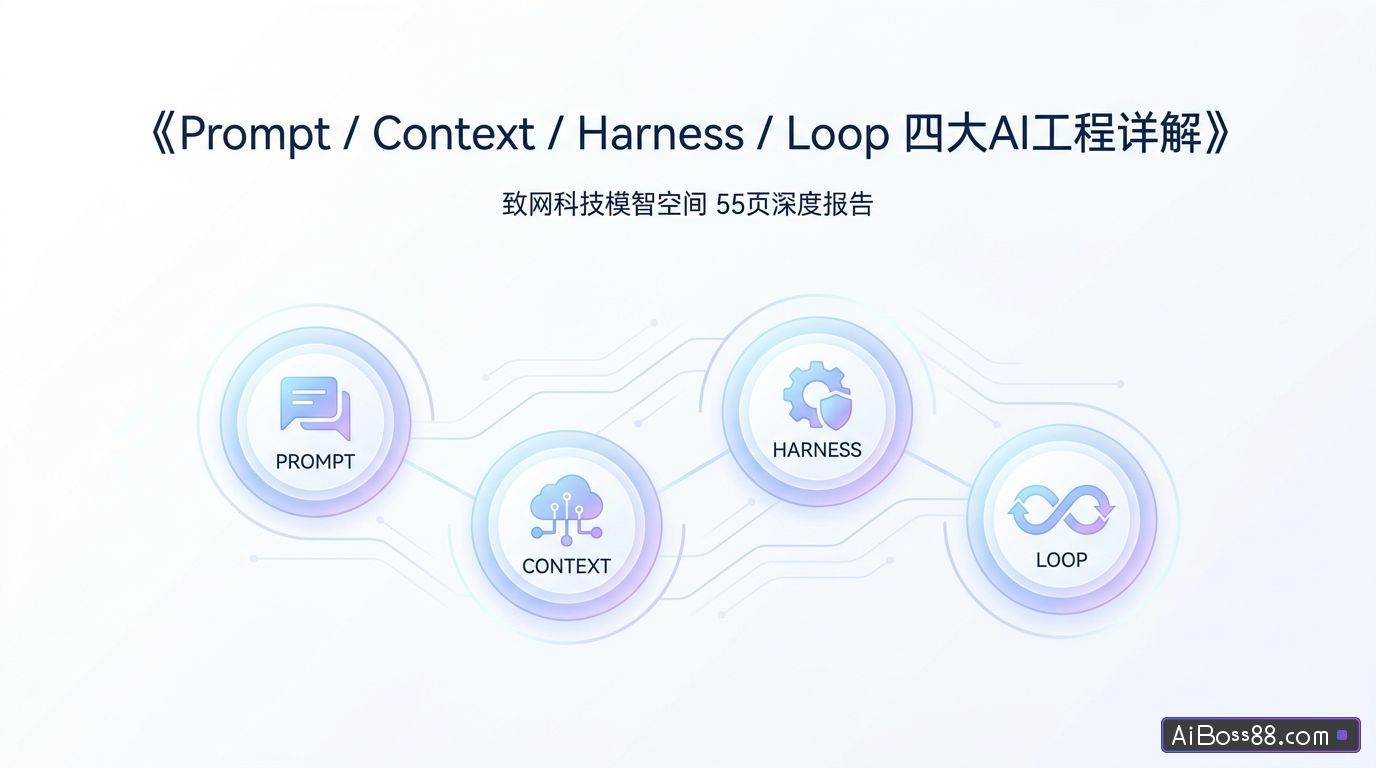
《Prompt /Context/Harness /Loop Big FourAI"Engineering Details" is a 55-page in-depth report launched by Zhiwang Technology's Model Space, which systematically proposes...PromptThe four major components: Context, Harness, and Loop.AIThe engineering system covers the entire chain from intent expression, information provision, secure execution to autonomous looping. The report proposes...AIThe project is evolving from a single question-and-answer session to a closed-loop execution model, requiring four layers of capabilities to work synergistically and without substitution; each layer is indispensable. A detailed explanation of the structured approach is also provided.PromptTemplates, RAG search enhancement,AgentSandbox safetyautomaticEngineering implementation methods such as workflow optimization and Skills accumulation.
Scan the QR code to follow our official WeChat account and reply with the following code:20260619,freeGet PDF report
From basic interaction to autonomous looping—AIEngineering Evolution
-
AIThe focus of the project has shifted from generating accurate answers to closed-loop execution.
-
Initially, it was a single question-and-answer model; now, it requires an execution chain consisting of understanding, retrieval, action, verification, and feedback.
-
A four-layer evolution architecture is proposed.:Prompt Engineering (expression), Context Engineering (information), Harness Engineering (execution), Loop Engineering (closed loop).
-
The four layers are not replacements, but rather collaborative additions.:PromptDefine the task, Context provides evidence, Harness executes it securely, and Loop reads the feedback.
-
Warning from counterexamples:onlyPromptLacking facts, having only context without action, having only Harness without a goal, and having only Loop prone to idling.
Prompt Engineering—The Precise Expression of Intent
- Core ObjectivesTransform vague intentions into executable tasks and regulate model behavior through input structure, task instructions, context boundaries, examples, and output protocols.
- Five core elements: Identity (limited perspective), Task (clear objective), Context (provides background), Constraints (define boundaries), Output (specify format).
- Tip 1 – Few-Shot: Use a few examples to concretize implicit business standards, output formats and boundary cases, which is suitable for tasks where it is difficult to write all the rules.
- Tip 2 – CoT and Self-ConsistencyCoT breaks down complex tasks into steps for derivation; Self-Consistency reduces single-item bias through multi-path reasoning voting.
- Control conditions and output structureThe same task can be output in different structures according to role (architect/customer service/product manager), audience (technical team/ordinary user/management), and scenario (fault review/customer notification/decision reporting).
- Engineering implementationEstablish a template library, example library, version management system, and failure sample library to achieve [the following].PromptIt is versionable, measurable, and rollbackable.
Context Engineering—A Window to Knowledge and Memory
- Core ObjectivesTo ensure the model sees the right information at the right time, context packages are generated through retrieval, filtering, sorting, compression, permission filtering, and reference binding.
- Context window managementThe original documents, historical conversations, and tool returns are organized into six major blocks according to priority: system instructions, current tasks, key evidence, recent conversations, tool results, and work status.
- RAG systemOffline indexing completes document collection, cleaning, segmentation, vectorization, and index building; online reasoning completes answer generation through query rewriting, recall, reranking, context assembly, model generation, and reference output.
- Agentic RAG EvolutionThe upgrade is from a single retrieval to a model that proactively determines whether the query needs to be rewritten, split into sub-questions, or continuously retrieved.
- Context assemblerThe function prioritizes, deduplicates, detects conflicts, filters permissions, and formats the input materials, outputting a usable context package.
- Long document processingIt supports long-cycle tasks by deduplication and trimming, abstract compression, evidence location, and key fragment extraction, combined with abstract writing and evidence retrieval.
- Multimodaldeal withIt unifies the processing of text, images, tables, code, logs, and webpage screenshots, generating a unified context package after regional positioning, table structuring, code semantics, log aggregation, and screenshot recognition.
Harness Engineering – System Safety Barrier
- background2025AgentIt has explosive power, but lacks reliability and suffers from problems such as infinite loops, forgetfulness, disregard for rules, and basic errors.
- System AnalogyThe model acts like a CPU, providing computing power; the context acts like memory, storing information; and Harness acts like an operating system, responsible for scheduling.AgentLike an application to complete a task.
- ETCLOVG frameworkExecution environment (E), tool interface (T), context and memory (C), lifecycle and orchestration (L), observability (O), verification and evaluation (V), governance and security (G).
- Execution environment: Achieving secure isolation (code/command/network restrictions) and reproducibility through sandboxingOne-clickReset (consistent with initial state) and increased autonomy (reduced manual authorization).
- Tool Interface: Through MCP (Model Context Protocol) and A2A (Agent-to-AgentStandardized protocols are used to address the issue that models cannot directly manipulate software interfaces, APIs, or command lines.
- Memory Management: Construct a three-layer system: short-term context (working memory), medium-term session memory (session-level cache), and long-term persistent memory (vector/graph database).
- Lifecycle orchestration:oneintelligentbodyCycle (ReAct: Think-Act-Observe-Reflect), MultipleintelligentbodyOrchestration (division of labor between planner, executor, and reviewer), and the entire pipeline (GitHub Issue → Development → Testing → PR).
- ObservabilityLink tracing (model/tool/context changes), cost and performance monitoring (token consumption, inference latency), and fault operation and maintenance (circular calls, environmental anomalies, inference failure).
- Verification and EvaluationThe process has been upgraded from focusing solely on the final score to comprehensive quality control, encompassing task definition, pre-run verification, data collection, multi-dimensional evaluation (results/tool rationality/efficiency/compliance), and regression iteration.
- Governance and SecurityAccess control (fine-grained authorization for files/networks/tools), execution hooks (pre- and post-checkpoints, intercepting violations), component hardening (preventing sandbox escape, preventing injection prompts), and auditing and compliance.
- TrilemmaQuality, speed, and cost are inversely related and must be traded according to the specific scenario.
Loop Engineering – Design and Autonomous Execution of Loops
- Core transformationFrom continuous manual driving by peopleintelligentbodyEvolution into a human design cycle, a cycleautomaticdriveintelligentbody.
- External circulation and internal circulationThe outer loop decides whether to start the next round, while the inner loop is responsible for what to do in this round.
- Six major components:
- Automations: Scheduled triggering, status scanning, and failure summary.
- WorktreesIsolate parallel tasks to avoid multipleintelligentbodyFile overwriting and code conflicts.
- Skills: Accumulate project knowledge (standards, processes, pitfalls) through SKILL.md, and configure it once for continuous reuse.
- Plugins & ConnectorsConnect to real-world environments such as ticketing systems, databases, Slack, CI, and APIs via MCP.
- Sub-AgentsRole splitting (exploration, development, review, verification) solves the blind spot of self-review and enables cross-validation.
- MemoryExternal persistent memory (Markdown/task board/status file) solves the problem of forgetting after restart and enables seamless continuation across loops.
- Four major projects summarized in one sentence:PromptThe solution is how to ask the question; the context helps resolve this.AIHarness sees something and solves it.AILoop determines the operating environment.AIWhat to do after completing one step?
- Three-stage evolutionStage 1 instruction drive (Prompt EngineeringSimple/Single round/static) → Phase 2 Information-driven (Context + Harness, multi-round dialogue/tool call, still requires manual intervention) → Phase 3 System-driven (Loop Engineering, long cycle/multi-step/autonomous iteration).
- natureFrom writing instructions to the model, to providing information and environment to the model, and then to building a system that can run on its own.
Scan the QR code to follow our official WeChat account and reply with the following code:20260619,freeGet PDF report